Leger Survey: Understanding the Construction Industry to Tackle the Project of the Century
News


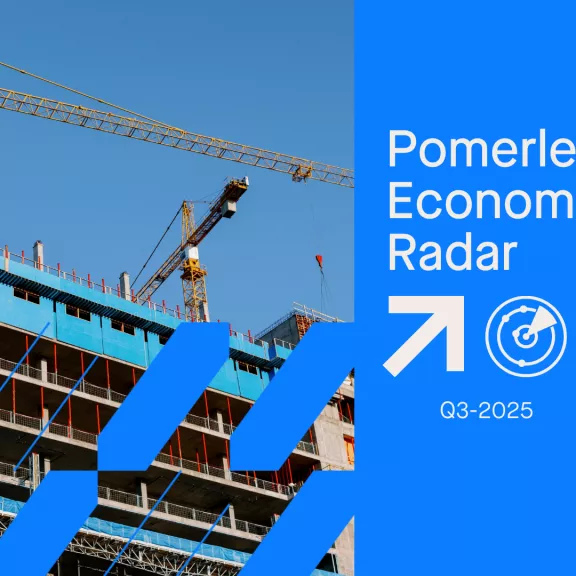
The construction market is evolving rapidly and remains marked by uncertainty. To help businesses and decision-makers make informed choices, Pomerleau publishes its Economic Radar: a tool that analyzes trends, anticipates challenges, and identifies opportunities. It’s designed for industry professionals and public and private decision-makers who want to build on solid foundations.
The third quarter of 2025 confirms that the sector must adapt quickly: new budget directions, major construction projects, and stricter material sourcing rules are reshaping the industry.
Our experts, Sean Boyer (Vice President of Preconstruction – Building) and Jean-François Perras (Lead of Economic and Statistical Expertise – Building), emphasize that success relies on two pillars:
In practice, this means adjusting processes rapidly, strengthening internal coordination, and anticipating logistical constraints before they become obstacles.
The government is investing in infrastructure, defense, and residential projects. These initiatives create opportunities but also challenges: careful planning is needed to avoid delays and control costs. Notably, construction GDP grew by 1.40% in Q3, outpacing overall industry growth (0.52%), driven by stable residential activity and strong engineering work.
Rules are changing: starting in November, federal projects must use Canadian steel and lumber. At the same time, counter-tariffs of 25% to 50% on certain metals (steel and aluminum) from the U.S. and China are complicating supply chains. The takeaway: adapt purchasing practices quickly and work closely with local suppliers.
This office is now central to anticipating risks, securing supplies, and maximizing opportunities under new regulations. Even as global supply chains return to pre-2020 levels, vigilance is essential to avoid disruptions.
For two consecutive quarters, permit values have declined: -6.32% compared to the previous quarter and -11.03% versus 2024. The industrial sector is hardest hit (-18.19%), while commercial projects show slight growth (+2.55%). This trend could slow investments, especially in non-residential construction.
Price gaps are widening: Québec shows a +7.50% increase, Montréal +5.15%, compared to a national average of +4.20%. Costs are rising particularly for steel structures and plumbing, while HVAC systems are declining. These differences require close monitoring of local markets to adjust budgets.
These new trends complicate supply chains and impose logistical constraints. According to our experts, Sean Boyer et Jean-François Perras, anticipating these impacts is crucial. Stronger coordination between teams and partners, combined with solid relationships and proactive planning, will turn challenges into opportunities.