New container terminal at the Port of Contrecœur
Marine Works
Contrecoeur, QC, CA


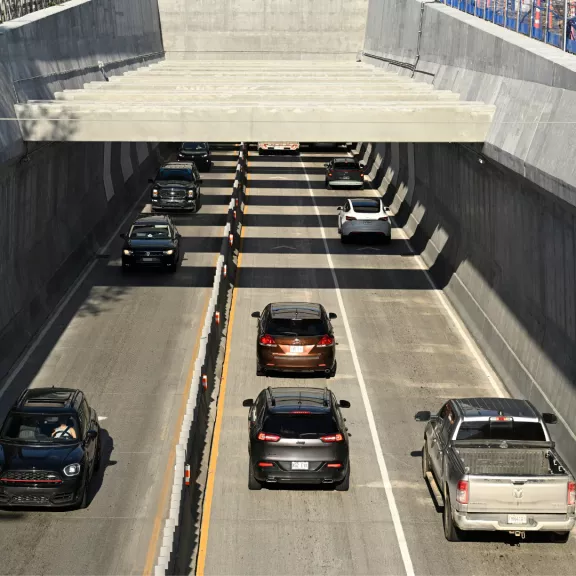
The Louis-Hippolyte-La Fontaine Tunnel, a strategic roadway linking Montréal to Longueuil, is undergoing a significant rehabilitation project. Built between 1963 and 1967, this 1.5-kilometre underwater tunnel, connected to a 457-metre bridge, used to accommodate 120,000 vehicles daily before the work began, 13% of which were trucks. After nearly 60 years of service, this iconic infrastructure is receiving a major overhaul to extend its lifespan by 40 years without further major intervention and to meet current and future mobility needs.
This large-scale project, carried out under a design-build-finance (DBF) model, is led by the Renouveau La Fontaine (RLF) consortium, composed of Pomerleau, Eurovia, and Dodin Campenon Bernard.
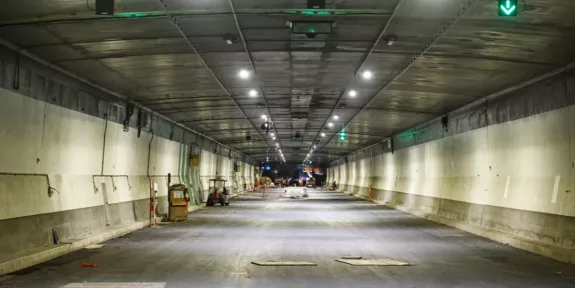
The work involves a complete modernization of the tunnel and its equipment: ventilation, drainage, pumping, fire protection, signage, and intelligent transportation systems. It also includes the rehabilitation of 13 km of pavement on Highway 25, the construction of a noise barrier, the addition of a reserved bus lane on westbound Highway 20, and the development of park-and-ride lots to promote public transit. The reopening of both traffic tubes with two lanes in each direction is scheduled for fall 2026, with full completion expected in 2027.
The complexity of this project goes far beyond a simple tunnel refurbishment. It begins with the advanced deterioration of certain structures, notably the ventilation towers, which require more extensive interventions than anticipated and innovative technical solutions. This reality forces teams to constantly adjust plans to ensure safety and quality.
Adding to this is a major logistical challenge: maintaining traffic flow on a strategic corridor while managing lane closures. Every decision must balance traffic mobility, user and worker safety, and operational efficiency, requiring close coordination between on-site teams and real-time traffic management systems.
Throughout the project, measures are implemented to limit noise, vibrations, and dust for nearby communities. Under the responsibility of the Ministère des Transports et de la Mobilité durable of Québec, clear and continuous communication on project progress, traffic changes, and mitigation measures is central to the strategy.
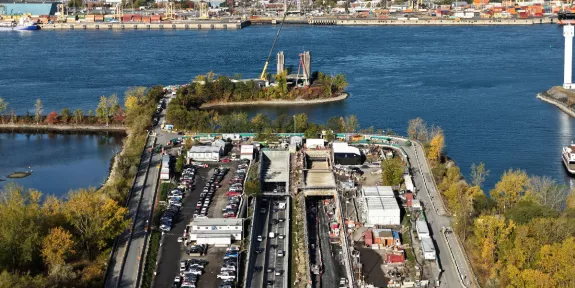
This project stands out for its rigorous approach to environmental management, supported by internationally recognized certifications. ISO 14001 certification ensures that the project’s environmental management system meets high standards. In practice, this standard requires processes to identify, control, and reduce environmental impacts related to construction activities, promoting continuous improvement and strict compliance with legal requirements.
At the same time, the construction activities of this project aim for carbon neutrality through audits compliant with the ISO 14064-3 standard. This standard governs the verification and validation of greenhouse gas (GHG) inventories by an independent body. It ensures the transparency and credibility of the data, which is essential to demonstrate that emission reduction targets are actually being met.
These commitments translate into concrete actions: using hybrid and electric vehicles to reduce emissions, recovering and treating 100% of water from hydrodemolition, training teams in eco-driving, and reusing soil and aggregates. The goal is ambitious: recover 80% of residual materials and minimize deforestation while respecting circular economy principles.
To meet these challenges, Pomerleau relies on innovative solutions such as hydrodemolition, intelligent transportation systems, specialized formwork tools, and ventilation systems. Modernizing electrical and safety systems and using advanced concrete formulas for fire protection demonstrate a commitment to integrating the best available technologies. On average, 400 people work on-site, with peaks reaching 800. Expertise spans civil engineering, mechanics and electricity, fire safety, environmental management, and communications.
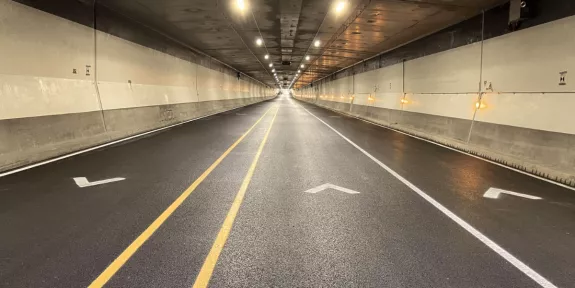
Beyond numbers and techniques, the rehabilitation of the Louis-Hippolyte-La Fontaine Tunnel represents a collective challenge and a major contribution to mobility in Québec. It is a unique opportunity to modernize an iconic infrastructure, enhance safety, extend its lifespan, and improve public transit for thousands of users.
Pomerleau is particularly proud to contribute its expertise to this major project, alongside its partners Eurovia and Dodin Campenon Bernard, within the Renouveau La Fontaine consortium. This collaboration illustrates the power of teamwork and the ability to combine complementary skills to meet exceptional technical and logistical challenges. Together, we share a common ambition: to provide a safe, sustainable infrastructure adapted to the needs of future generations.