Province House Restoration
Governmental
Charlottetown, PE, CA
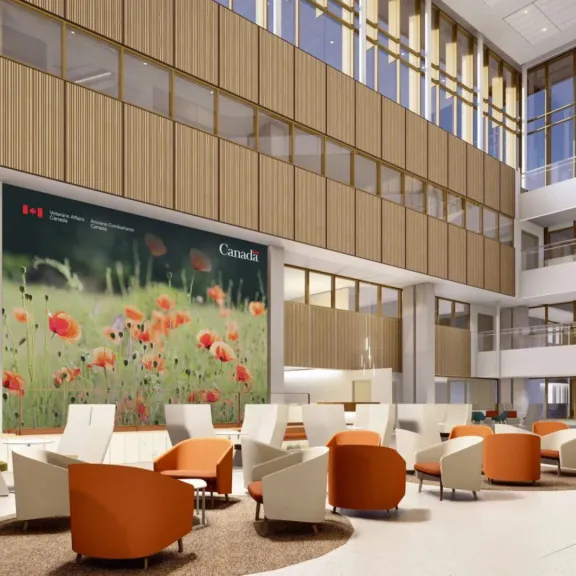
Photo © NORR | Architecture, Engineering, Interior Design & Planning Firm
Federal government buildings are essential to public service delivery and demonstrate evolving standards in sustainability, accessibility, and workplace efficiency. Through the Daniel J. MacDonald Building Modernization Project, Pomerleau is contributing to the rehabilitation and optimization of a key federal asset in Charlottetown, Prince Edward Island. The project will turn an aging facility into a modern, efficient, and sustainable workplace for Veterans Affairs Canada.
Located at 161 Grafton Street in Charlottetown, the Daniel J. MacDonald Building was constructed in 1983 and serves as the national headquarters for Veterans Affairs. Pomerleau was awarded the modernization contract to extend the building’s life cycle and align it with Government of Canada workplace standards.
This project will deliver a renewed facility designed to support modern work practices and enhance occupant comfort. It will also improve long-term operational efficiency while ensuring continuity for essential federal services.
To resolve performance limitations and reduce greenhouse gas emissions, the scope of work includes replacing and modernizing the building’s aging mechanical and electrical systems. Heating, ventilation, air conditioning, and electrical infrastructure will also be upgraded to enhance reliability, energy efficiency, and environmental performance.
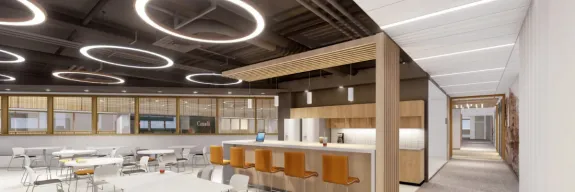
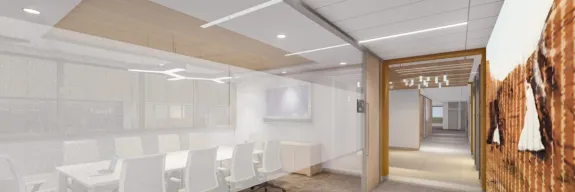
Interior spaces are being comprehensively renovated to meet contemporary federal workplace requirements. This includes the demolition of outdated interior finishes and the restoration of select areas of the existing concrete building frame. A major architectural upgrade involves replacing the original sloped atrium glazing with a new roof and vertical curtain wall, which will improve durability, thermal performance, and daylight control, while renewing the building’s central gathering space.
As part of the modernization, bird deterrent window technologies have been integrated into the new atrium, along with strip windows throughout the office space to promote environmental stewardship and protect wildlife. In addition, to reinforce the building’s role as a collaborative federal workplace, the renewed atrium includes acoustic wall coverings for sound control and a stage for presentations and gatherings.
The building’s concrete slabs were not originally designed to support the quantity of material required to address floor deflections, so structural modifications were needed to ensure long-term performance and safety.
It is not uncommon to encounter challenges when integrating modern finishes into an existing structure that has dimensional deviations. The DJM modernization was no exception, and some conditions required adaptive solutions, careful coordination, and close collaboration between design and construction teams.
The project is also being delivered within a small regional construction market. Specialized trades are scarce in Prince Edward Island, so contractors from outside the province have been mobilized. This adds logistical complexity that must be managed to maintain schedule and quality.
Environmental performance is a core objective of the Daniel J. MacDonald Building Modernization. The project includes the integration of geothermal heating, supporting reduced reliance on fossil fuels and contributing to long-term emissions reductions. Upgraded mechanical and electrical systems further support energy efficiency and lower operational costs.
The project is seeking Green Globes Certification Level 3 or better, a rigorous environmental rating system that evaluates energy efficiency, water conservation, and sustainable building practices. This certification aligns with the Government of Canada’s objectives to reduce its carbon footprint and modernize federal real estate responsibly.
Environmental management measures also include dust and noise mitigation strategies, which are essential, given the building’s proximity to neighbouring structures located just a few feet away.
In alignment with federal objectives for reconciliation and economic inclusion, the project aims to award 10 percent of contract work to Indigenous businesses. This commitment supports Indigenous participation in federal construction projects and encourages long-term capacity building through meaningful involvement across the supply chain.
Innovation plays a central role in addressing the project’s technical complexity. Pomerleau deployed in‑house LiDAR three‑dimensional scanning, a laser‑based surveying technology used to capture highly accurate measurements of existing conditions, to analyze slab deflections and determine the precise amount of material required to achieve level floors. This approach enabled informed decision‑making while remaining efficient and cost conscious.
The OpenSpace visual intelligence platform, which uses 360‑degree imagery and AI to create a complete visual record of construction progress, is also being used to support documentation, coordination, and transparency throughout the modernization process.
Pomerleau’s experience with large-scale renovation projects and its deep understanding of this federal client have been instrumental in the project’s execution. Bringing LiDAR scanning capabilities in-house allowed the team to respond quickly to complex conditions while maintaining control over quality and budget.
As noted by Project Director Ken Aucoin, "Taking advantage of our internal LiDAR expertise was extremely efficient, allowing us to manage the budget even more carefully." This expertise, combined with strong coordination and renovation experience, supports the successful delivery of this highly technical modernization project.
Through the Daniel J. MacDonald Building Modernization project, Pomerleau is proud to support Veterans Affairs Canada by delivering a modern, sustainable, and efficient workplace that meets the needs of today’s public servants while reducing environmental impact. By combining technical innovation, renovation expertise, and collaborative delivery, this project ensures that a critical federal asset will continue to serve Canadians effectively for years to come.