Toronto’s Multi-Function Paramedic Station
Health and Research
Scarborough, ON, CA
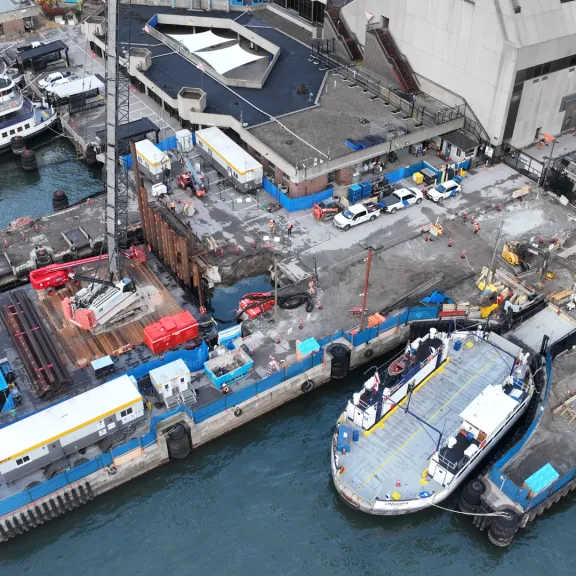
The Jack Layton Ferry Terminal – Shoreside Infrastructure project is a landmark infrastructure project that supports the City of Toronto’s transition toward a more sustainable future. At the Jack Layton Ferry Terminal, Pomerleau is delivering complex civil and marine construction at one of Toronto’s most critical transportation hubs. The project supports the arrival of a new fleet of two electric ferries, replacing aging diesel vessels while maintaining uninterrupted service between the mainland and the Toronto Islands.
Executed in a fully operational environment, this work combines marine, special projects, civil and structural expertise to ensure that the terminal continues to serve residents, schoolchildren, emergency services and visitors throughout every phase of construction.
Located at the heart of Toronto’s waterfront, the Jack Layton Ferry Terminal is both a vital transportation link and a highly visible public space. It connects a permanent island community, including families and schoolchildren, while also serving as a gateway for thousands of daily users travelling to and from the Toronto Islands.
For the City of Toronto, installing this infrastructure is essential. The project enables the transition to electric ferries, aligning with broader environmental objectives while ensuring that the terminal continues to meet operational needs for decades to come.
Pomerleau is upgrading the terminal’s marine infrastructure to accommodate a new generation of electric ferries. This requires precise modifications to existing docking systems, as well as in-water construction to ensure that new vessels can safely and efficiently berth.
The work also anticipates the integration of charging infrastructure for two additional future electric ferries, positioning the terminal to eventually support a fully electrified fleet. Because the new ferries differ in size and operational requirements, adjustments to structural elements and fender systems are necessary to ensure long-term performance and reliability.
One of the defining aspects of the project is the need to maintain continuous ferry operations throughout construction. The terminal remains active at all times, requiring uninterrupted access for passengers, emergency services, and essential operations.
Pomerleau sequences the work carefully to ensure that construction activities can progress safely without disrupting service. This involves constant coordination, daily planning, and real-time adjustments to respond to site conditions as they occur. In a high-traffic environment where public circulation passes directly through or alongside work zones, maintaining safety and operational continuity is central to every decision made on site.
The project involves a wide range of marine and civil construction activities, many of which are self-performed by Pomerleau. Working directly in the harbour, teams carry out underwater construction, install structural elements, and adapt existing infrastructure to meet new operational requirements.
These operations are carried out in constrained conditions, requiring precise coordination of equipment, including cranes and marine assets, as well as close collaboration between specialized trades. The presence of water, combined with limited space and continuous activity around the site, adds a level of complexity that demands both technical expertise and disciplined execution.
Design adjustments, often driven by the operational needs of vessel operators, are integrated into the construction process. This requires rapid mobilization of engineering resources and the ability to make informed decisions directly on site.
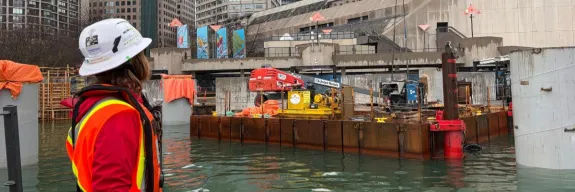
Working in a harbour environment introduces a unique set of constraints. Construction must account for security requirements, restricted access zones, and the logistical challenges of operating in a dense urban waterfront setting.
Seasonal conditions also play a critical role. Cold temperatures and ice formation impact marine operations, requiring additional planning and specialized techniques, particularly for underwater work. Despite these constraints, construction progresses while maintaining safety, quality, and schedule commitments.
Environmental considerations are fully integrated into the project. Working in Lake Ontario requires strict adherence to environmental regulations and proactive mitigation measures. Pomerleau implements fish rescue operations before any in-water work, along with continuous environmental monitoring and spill prevention measures. These actions are embedded in daily operations to ensure that any impact from construction activities on the surrounding ecosystem is minimized and that all regulatory requirements are met.
A significant portion of the project is delivered by Pomerleau’s own teams, including civil and marine construction. This self-perform approach provides greater control over execution and allows for faster response to evolving site conditions.
The project also draws on expertise from across the organization, including our special projects, civil and infrastructure, and design teams. Engineering support and specialized resources are mobilized as needed, enabling efficient coordination and informed decision-making. This ability to integrate expertise across disciplines is key to delivering complex infrastructure projects in active environments.
Installing the first caisson with our team and our own equipment was a defining moment. It showed what we are capable of, and it is something we can all be proud of when we see people using this terminal every day
The Shoreside Infrastructure project at the Jack Layton Ferry Terminal supports a critical transition toward sustainable transportation while maintaining a vital connection between Toronto and its island communities.
Pomerleau is proud to contribute to this landmark project, bringing its expertise in marine construction and its ability to execute work in complex, active environments. Through this approach, Pomerleau is delivering infrastructure that meets today’s needs while preparing the city for the future.