Bonaventure Expressway
Transportation
Montréal, QC, CA


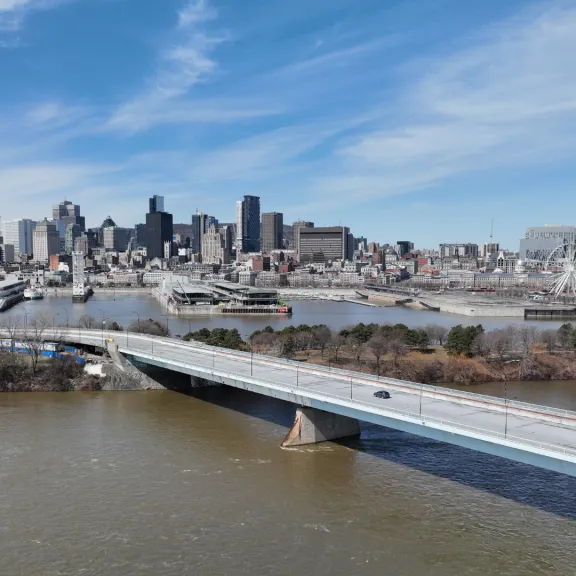
Built for Expo 67, the Concorde Bridge has been part of Montréal’s landscape for more than 50 years. It connects the city to Parc Jean-Drapeau and the Casino, providing a well-used crossing for pedestrians, cyclists, runners, and motorists every day. More than just a link between two shores, it is a bridge deeply woven into Montréal’s daily and recreational life.
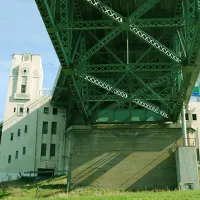
Over time, its steel structure began showing signs of wear and fatigue. A major rehabilitation was required to ensure user safety and extend the lifespan of this iconic piece of infrastructure while meeting evolving environmental standards. The City of Montréal sought to restore the bridge’s reliability and functionality for decades to come.
The rehabilitation of the Concorde Bridge took place in an active urban environment where coexistence between the construction site and users was essential. Although the bridge is not one of the city’s busiest roadways, it remains heavily used by pedestrians and cyclists, requiring constant attention to safety and traffic flow throughout the work.
Delivered under a lump-sum contract with the support of several specialized subcontractors, the project required rigorous coordination and continuous adaptability to maintain site accessibility throughout the construction period.
Pomerleau was selected for this project in part because of its technical expertise in the rehabilitation of orthotropic bridge decks, a specialized capability that remains relatively uncommon in Québec. Made entirely of steel, this type of bridge deck is known for its lightweight design and exceptional strength. However, it also demands a high level of precision and specialized expertise during installation, welding, and maintenance activities.
This specialized know-how enabled the team to work effectively on an atypical structure while meeting the demanding performance and durability requirements associated with this type of infrastructure.
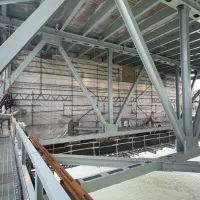
At the same time, the project team implemented an innovative execution strategy by using under-bridge platforms (inverted work platforms) instead of traditional scaffolding. This methodological choice helped reduce costs, simplify work beneath the structure, and improve overall project efficiency. It also minimized disruptions for users and facilitated construction activities within a constrained urban environment.
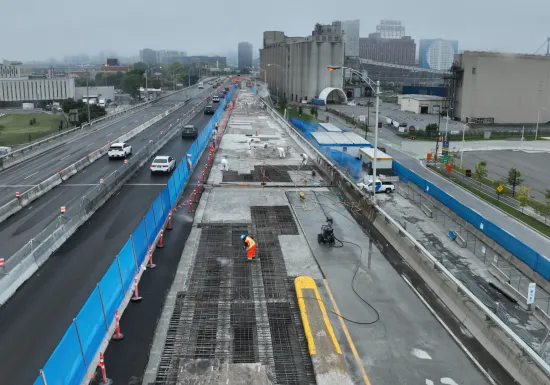
The project included the complete rehabilitation of the roadway surface, refurbishment of the guardrails, repairs to the steel sidewalks, and replacement of the lighting system with higher-performance luminaires positioned more effectively.
The construction site presented several significant technical challenges, including the complexity of the atypical steel structure and the presence of lead-contaminated paint. Rigorous contaminant management practices and strict procedures were implemented to ensure the safety of workers, users, and the surrounding environment. The project was carried out by a deliberately lean team structure, promoting agility and enabling rapid decision-making throughout the work.
For certain operations, the teams used hydrodemolition, a highly precise technique that employs ultra-high-pressure water jets to remove membranes and deteriorated materials without damaging the underlying structure. This method minimizes vibration, preserves the sound portions of the infrastructure, and supports compliance with environmental standards through the recovery and filtration of the water used during the process.
Beyond the rehabilitation of the Concorde Bridge itself, the project helped strengthen a rare area of expertise in Québec and further enhanced Pomerleau’s ability to work on complex steel structures. It is a project the teams are proud of, both for the technical excellence delivered and for the innovative, people-focused approach maintained throughout every stage of the work.