The Concorde Bridge
Transportation
Montréal, QC, CA


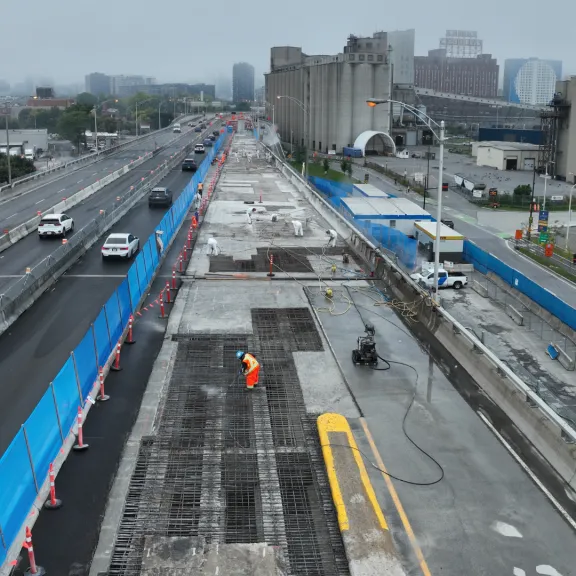
Every day, nearly 100,000 vehicles travel along Autoroute Bonaventure to enter or leave downtown Montréal. As a strategic corridor connecting the city’s economic core to the Champlain Bridge and Montréal’s South Shore, this infrastructure plays a vital role in the daily mobility of residents and the efficient movement of people and goods throughout the region.
Over time, the concrete slabs and drainage systems in certain sections began showing significant signs of deterioration. A major rehabilitation project became necessary to extend the lifespan of the infrastructure and ensure user safety, all while maintaining traffic flow in an area where any lane closure can have immediate consequences.
The project was carried out in a highly constrained environment where traffic had to be maintained at all times. Reducing three lanes to two in an already heavily travelled corridor required meticulous planning and close coordination to minimize disruptions to daily commuters.
As construction progressed, the volume of repairs ultimately doubled, creating significant pressure on the original schedule. Winter conditions added further complexity, making planning and execution more challenging on a highway corridor that needed to remain fully operational.
Faced with these unforeseen circumstances, the teams demonstrated exceptional adaptability. Pomerleau established an in-house concrete removal crew, consisting of skilled workers specialized in the controlled removal of damaged concrete. Their role involved precisely demolishing areas requiring repair while preserving the sound portions of the structure, a critical step before rehabilitation work could begin. By developing this expertise internally, the teams were able to address the shortage of specialized subcontractors, accelerate project progress, and maintain construction momentum despite the increased scope of work.
The project included concrete slab repairs, replacement of bridge deck joints, complete rehabilitation of the drainage system, and installation of a new waterproofing membrane and fresh asphalt pavement.
These activities required highly precise execution within restricted work windows, often during nighttime hours or weekends, to reduce impacts on traffic. Construction operations were continuously adjusted to meet operational requirements and respond to changing site conditions.
Hydrodemolition played a central role in the execution of the repairs. This technique enabled crews to work with precision on damaged sections while preserving sound concrete and minimizing vibration-related impacts to the structure.
Particular attention was also given to health and safety considerations, especially regarding silica exposure and the management of water generated through the hydrodemolition process. Rigorous measures were implemented to protect workers and ensure compliance with applicable environmental regulations and industry standards.
Beyond the rehabilitation work itself, this project demonstrates Pomerleau’s ability to transform a complex construction challenge into a successful outcome through adaptability, innovation, and close collaboration with the client. It is an accomplishment the teams are proud of, marked by dedication, technical rigour, and a shared commitment to maintaining mobility along one of Montréal’s most critical transportation corridors.