


Pomerleau Celebrates 60 Years
Culture

Since its beginnings in the Beauce region in the mid-1960s, Pomerleau has grown alongside Quebec. From a team of five led by Hervé Pomerleau to a company operating from coast to coast, our story began here in Quebec, building schools, hospitals and transportation networks that support everyday life in our communities
Over the decades, needs have changed, projects have grown in scale, and construction methods have evolved. Behind this growth is a lasting commitment: to build living environments that meet the needs of Quebecers. With more than 60 years of history, let’s take a look back at the milestones of a journey closely tied to Quebec’s transformation.
In 1964, as major projects of the Quiet Revolution transformed Quebec, Hervé and Laurette Pomerleau chose to embark on their entrepreneurial journey in their native Beauce region. In the basement of their family home, a company began to take shape that would grow far beyond its regional roots. With a team of five employees, Hervé Pomerleau went into business and officially founded Hervé Pomerleau inc. in 1966.
The company’s first contract was an elementary school expansion in Saint-Bernard, in the Beauce region. Modest compared with the major projects that would follow, it nonetheless marked the beginning of a story closely connected to the needs of Quebec communities.
At the time, Quebec was investing heavily in its school systems to accommodate population growth and make education more accessible. The Saint-Bernard school expansion made room for more students and helped improve the community’s educational infrastructure. For local families, it was a tangible investment in their children’s future.
This first project set the direction for Pomerleau’s growth: building infrastructure that supports community development. Rooted in Beauce, the company was contributing from its earliest years to the changes that would shape modern Quebec.

During the 1970s, Pomerleau grew rapidly and established itself as one of Quebec’s leading builders of regional shopping centres. This period coincided with economic growth in several municipalities and changing consumer habits.
Across the regions, these new shopping centres brought together stores and services that had previously been scattered or concentrated in major cities. Their construction helped stimulate local economic activity, create jobs and give families easier access to the products and services they needed every day.
The decade also marked a turning point in the diversification of Pomerleau’s activities. In 1973, the company helped build the Lac-Mégantic dam, one of its first civil engineering projects. This was an important step in developing new expertise and paved the way for greater involvement in infrastructure projects.
In 1978, Pomerleau secured its first design-build-lease contract for Hydro-Québec’s administration and service centre in Montmagny. This approach brought different areas of expertise together on a single project and improved coordination across the stages of delivery. The building supported the operations of Hydro-Québec, an organization essential to the province’s energy and economic development. From commercial infrastructure to civil engineering works, Pomerleau broadened its activities while contributing to growth across Quebec’s regions.
In the 1980s, Pomerleau evolved from a regional company into a leader with a presence in Quebec’s major urban centres. Opening offices in Montréal in 1980 and Québec City in 1988 brought its teams closer to decision-makers, local partners and the distinct realities of each area. This presence made it easier to bring local suppliers and workers together on larger projects. In 1986, the company ranked first among general contractors in Quebec.
The decade also confirmed the expansion of Pomerleau’s capabilities. At the Reynolds smelter in Baie-Comeau, Pomerleau’s first major civil engineering project, 75,000 cubic metres of concrete were poured in five months. The project supported an important industrial operation on the North Shore and demonstrated that highly complex work could be delivered in regional settings. In 1989, Pomerleau secured the contract for 1000 De La Gauchetière. With its 56 storeys, the building became a downtown Montréal landmark, bringing more workspace into the heart of the public transit network.
The 1980s also saw the beginning of Pomerleau’s maple syrup tradition. Initially offered to clients, this iconic Quebec product also gradually became an annual gift for employees and partners. Today, the tradition continues to reflect the company’s attachment to its roots, Quebec expertise and the lasting relationships it maintains with the people who contribute to its story.
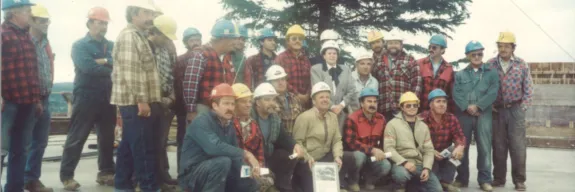
The 1990s began in a difficult economic climate. The recession slowed activity in the construction industry and prompted companies to adapt their practices. For Pomerleau, this period became an opportunity to further diversify its markets, consolidate its expertise, and strengthen its ability to deliver large-scale projects. Despite the economic challenges, the company continued to contribute to projects of importance to Quebec communities.
In northern Quebec, work on the LG-1 hydroelectric generating station in James Bay contributed to the development of Quebec’s electricity generation network. This infrastructure plays an essential role in supplying electricity to homes, businesses and public services, while generating economic activity in the regions where it is located.

In the Outaouais region, the construction of Casino du Lac-Leamy helped establish a major tourism and entertainment destination. By attracting visitors and supporting surrounding tourism and commercial activities, the project contributed to the region’s economic vitality.
In 1996, Pomerleau reached its 1,000th contract with the Saint-Nicolas wastewater treatment plant. Less visible than a tower or a major complex, this infrastructure nonetheless plays a direct role in public health, waterway protection and a municipality’s ability to welcome new residents. During the same period, the company established its first board of directors and prepared for the transition to the second generation of the Pomerleau family. This stronger governance enabled it to take on more essential projects while maintaining the regional roots that had shaped its beginnings.
At the turn of the millennium, Pomerleau continued to expand its markets and expertise, with Quebec remaining central to many of its major projects. In healthcare, projects involving the Jewish General Hospital and McGill University’s research centre improved spaces dedicated to care and provided medical and scientific teams with environments suited to their work. At Concordia University, construction supported the accommodation, education and daily lives of a growing student population. These buildings enable services that thousands of patients, students, researchers and families rely on every day.
The period also brought diversification in the energy sector. In 2004, the creation of Borea Construction strengthened the group’s renewable energy expertise. Meanwhile, work on the La Romaine hydroelectric complex illustrated the importance of major energy projects to Quebec’s development. Delivering these projects required a wide range of expertise and extensive coordination in areas far from major urban centres. These construction sites also contributed to regional economic activity through the involvement of workers and suppliers.
A commitment to more sustainable construction practices also became increasingly important. Completed in Montréal in 2011, the Maison du développement durable earned LEED Platinum certification for New Construction in 2013, a first in Quebec. Beyond its environmental performance, the building provides a place to work and meet for organizations committed to the ecological transition. It also demonstrates how design choices, materials and energy efficiency can help reduce the environmental footprint of buildings.

From the mid-2010s onward, Pomerleau strengthened its presence across Canada while continuing to deliver major projects in Quebec. This growth has been accompanied by evolving expertise and new approaches to meeting communities’ long-term needs.
In healthcare, Phase 2 of the CHUM completes a major hospital and university complex in central Montréal. The project brings care, research and teaching spaces together in one environment, making it easier for teams to collaborate and for patients to access specialized services. The new Vaudreuil-Soulanges hospital will address the same need at a regional level: bringing care closer to a rapidly growing population and helping ease pressure on neighbouring facilities.
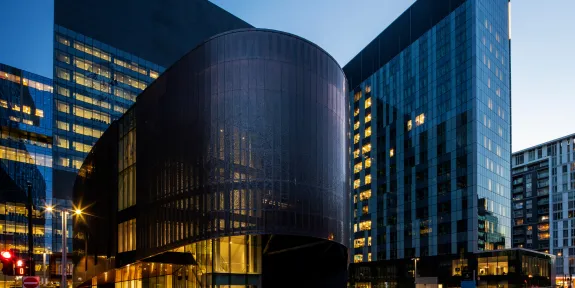
In transportation, Pomerleau is helping deliver the Réseau express métropolitain (REM) as part of the NouvLR consortium, contributing to one of Quebec’s major public transit projects. With its planned 67-kilometre network and 26 stations, the REM aims to improve connections between Montréal, the South Shore, the West Island, the North Shore and Montréal-Trudeau airport. For the communities it serves, these new connections offer more travel options and make it easier to reach jobs, educational institutions and services.
In 2024, Pomerleau and its partners also began work on the Montréal métro Blue line extension, a project intended to improve public transit service in the city’s east end. By bringing the métro closer to residential neighbourhoods, businesses and activity centres, this infrastructure will make daily travel easier for thousands of residents.
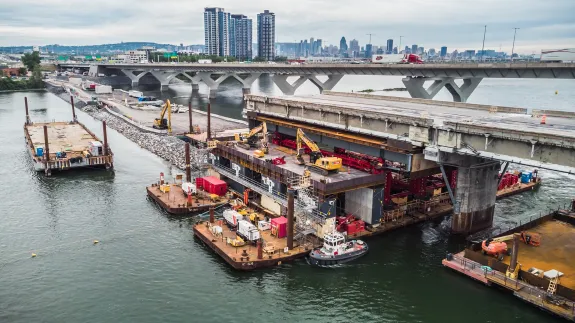
Other projects reflect the importance Pomerleau places on preserving, transforming and renewing existing infrastructure. The deconstruction of the Champlain Bridge, carried out in a sensitive environment in collaboration with The Jacques Cartier and Champlain Bridges Incorporated (JCCBI) and Delsan-A.I.M., required rigorous materials management and measures to protect the natural environments of the St. Lawrence River. The replacement of the Olympic Stadium roof, undertaken in a consortium with Canam Group, contributes to preserving an iconic part of Montréal’s heritage and ensuring the long-term viability of its facilities.
Whether building new infrastructure or working on existing structures, these projects share a common goal: supporting quality of life in Quebec communities and meeting the needs of current and future generations.
From the expansion of an elementary school in Beauce to today’s major transportation, healthcare and energy projects, Pomerleau’s history has unfolded alongside that of modern Quebec. Behind every project is a tangible impact on community life: a school that welcomes more children, an industrial facility that supports the regional economy, a wastewater treatment plant that protects waterways, a hospital that brings care closer to home or a transportation network that makes daily travel easier.
More than 60 years after its beginnings, Pomerleau remains deeply connected to Quebec. This is where the company took root, developed its expertise and built lasting relationships with the workers, partners, clients and communities that have contributed to its growth.
Today, even as its operations extend from coast to coast, this heritage continues to guide its growth. Its impact is measured not only by the infrastructure it builds, but above all by what that infrastructure makes possible: learning, receiving care, travelling, working and shaping the future. It is a story that continues, one construction site at a time, with the same commitment to helping build the Quebec of tomorrow.

