Soprema Production Plant
Industrial
Woodstock, ON, CA
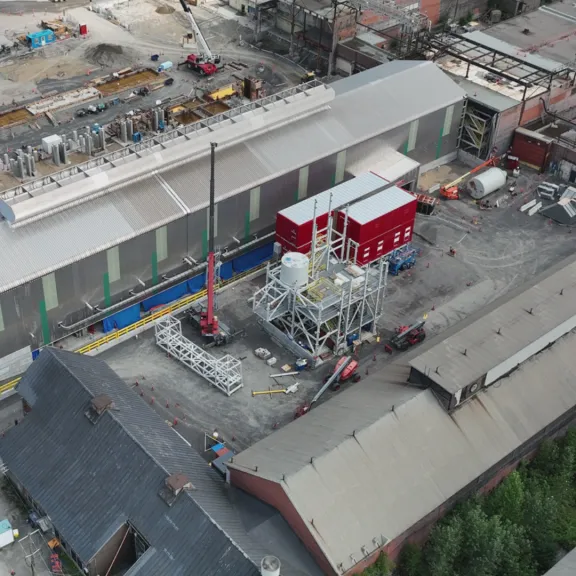
At Arvida, in Quebec’s Saguenay–Lac-Saint-Jean region, Pomerleau is supporting Rio Tinto in the construction of a specialized industrial facility within an operating aluminum smelter. Delivered in a highly technical and secure environment, the project draws on Pomerleau’s expertise in heavy industrial construction, complex project management and multidisciplinary coordination on an active industrial site.
Designed on a smaller scale than a conventional potroom, the facility will support various testing and optimization activities in an industrial environment. With only seven pots, the facility stands apart from traditional aluminum smelters through its more compact footprint and specialized purpose. For Pomerleau’s teams, the challenge is to deliver robust, flexible industrial infrastructure in an environment with particularly demanding technical, logistical and operational requirements.
Rio Tinto selected Pomerleau as general contractor and construction manager for the complete delivery of the facility. This decision reflects both Pomerleau’s experience on major industrial projects and its ability to integrate practical technology solutions that enhance site management and construction progress tracking.
From the outset, the teams implemented an ArcGIS-based platform to track construction progress in real time, including completed foundations, installed structural steel tonnage, and various production and health and safety indicators. This is complemented by tools such as 4D modelling, which links the model to the construction schedule; Revizto for multidisciplinary coordination; and drone flights to document the progress of the work. Together, these tools provide clear visibility into project progress, improve decision-making and optimize coordination in a highly technical industrial environment.
The construction site is integrated into an industrial facility already heavily occupied by Rio Tinto’s existing operations. With limited space available, the teams must carefully coordinate truck traffic, work areas, deliveries, equipment movements and the simultaneous activities of multiple specialized contractors.
Work began with the demolition of existing buildings, followed by excavation, the management of decontaminated soil and modifications to the existing stormwater system. The teams then constructed the conventional foundations for the potroom and installed precast slabs arranged into wide and narrow aisles, prior to the erection of the industrial steel structure. The building’s aluminum envelope directly echoes the material produced on-site.
As with many heavy industrial construction projects, the teams must also manage tight schedules, stringent health and safety requirements, and the coordination of a specialized workforce within an industrial environment that has been operating for several decades.
The project also stands out for the stringent access control, confidentiality and security requirements specific to the Arvida industrial site. These considerations directly influence construction planning, site organization and coordination methods among the various stakeholders. Risk management, health and safety procedures, and the daily coordination of activities play a central role in delivering the project while maintaining the operations of the existing site.
One of the project’s distinctive features is the integration of prefabricated electrical rooms that are fully assembled and tested in the factory before being delivered to the construction site. This approach reduces on-site work, improves quality control and optimizes the construction schedule. It marks a first for Pomerleau in this specific industrial context.
The project also draws on specialized industrial electromechanical expertise, particularly for grounding systems, electrical rooms and coordination with the site’s equipment. In the later stages of the project, the teams will also contribute to the construction of the gas treatment centre (GTC), a building that is essential to the facility’s operations.
The project currently employs nearly 100 people, with a peak workforce of approximately 175 workers expected across two shifts. A significant portion of the workforce comes from the Saguenay–Lac-Saint-Jean region, including workers transitioning from other major Rio Tinto industrial projects nearing completion in the area.
Rio Tinto is also contributing to the evolution of the digital tools implemented by Pomerleau and uses some of the tracking platforms in its own internal presentations. This collaborative approach fosters a true spirit of partnership between the teams.
The project currently employs nearly 100 people, with a peak workforce of approximately 175 workers expected across two shifts. A significant portion of the workforce comes from the Saguenay–Lac-Saint-Jean region, including workers transitioning from other major Rio Tinto industrial projects nearing completion in the area.
For Pomerleau, this project is particularly significant because it combines heavy industrial construction, jobsite innovation and close client collaboration in a complex environment. It is also an opportunity to demonstrate the teams’ ability to deliver demanding industrial projects with rigour, agility and collective intelligence. Pomerleau is proud to contribute to the delivery of this specialized industrial facility alongside Rio Tinto and to support a project that will help advance the industrial sector in Saguenay–Lac-Saint-Jean.